


Our structure and function
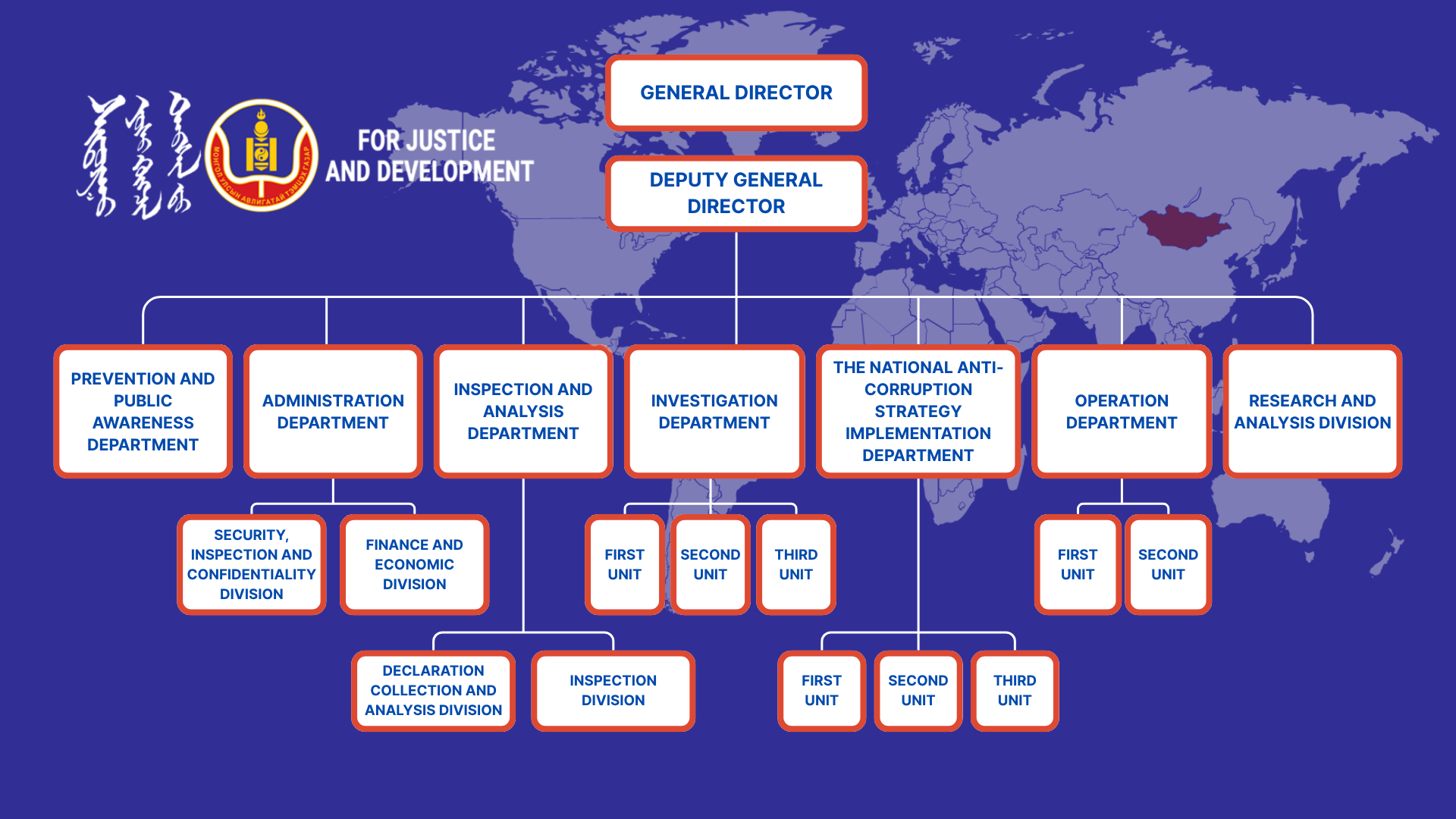
The Prevention and Public Awareness Department
The Prevention and Public Awareness Department addresses corruption risks through multifaceted approaches aimed at identifying and eliminating them.
In particular, it identifies corruption risks, oversees the implementation of legislation, and conducts monitoring and evaluation, while regularly organizing activities to ensure transparency in the operations of public institutions. In this context, it issues recommendations and requirements to public institutions and officials and provides support to ensure their implementation.
Moreover, during the investigation of corruption cases, it analyzes the outcomes of investigator’s notices issued to identify and eliminate the causes and conditions of crimes, and ensures that improvement measures are taken.
Additionally, it reviews draft laws and internal rules and regulations adopted by public institutions and takes measures to reduce the risks of corruption and conflicts of interest.
The Inspection and Analysis Department
The Inspection and Analysis Department carries out its functions in accordance with the Anti-Corruption Law and the Law on the Regulation of Public and Private Interests and Prevention of Conflicts of Interest in Public Service. Its activities are organized in the following four areas:
First, it administers the Declarations of Private Interests, Income, and Assets submitted by public officials, and regularly provides guidance and training to authorized officers of central and local government institutions.As of 15 February 2026, a total of 50,236 public officials have submitted their annual Declarations.
Second, it conducts both planned and unplanned verification of Declarations of Private Interests, Income, and Assets. In 2025, 110 declarations were verified and resolved. Furthermore, in the first quarter of 2026, an illicit enrichment case was identified through declaration inspections. In line with the internationally recognized practice of an “Unexplained Wealth Order,” MNT 45,000,000 that a public official “A” could not justify as lawfully acquired was confiscated and transferred to the state budget.
Third, it reviews the Preliminary Declarations of Private Interests submitted by candidates for public office. In 2025, a total of 19,287 preliminary declarations were reviewed and informed to the competent authorities or officials.
Fourth, it conducts an inspections of complaints related to conflicts of interest submitted by legal entities, organizations, and citizens. In 2025, a total of 945 complaints were reviewed and resolved in accordance with the law.
The Investigation Department
Within the organizational structure of the Independent Authority Against Corruption (IAAC), there is an Investigation Department responsible for registering and investigating cases. The department conducts investigations into corruption-related offences specified in Chapter 22 of the Criminal Code of Mongolia, self-detected money laundering cases, as well as complaints and information indicating potential criminal offenses, in accordance with Order A/73 of 2024 issued by the Prosecutor General. It carries out investigative activities for each criminal case.
At the national level in Mongolia, the department is currently handling complaints, information, and criminal cases involving corruption and offences committed by law enforcement officials, and is operating under a high workload.
According to Order A/09 dated 2 February 2023 issued by the Director of the IAAC, the structure and staffing are approved as follows:
- Head of the Investigation Department
- Complaint and Information Officer
- Technical Staff
- Investigation Unit I
- Investigation Unit II
- Investigation Unit III (Corruption and Money Laundering Cases
The Operations Department
The Operations Department of the Independent Authority Against Corruption (IAAC) is a specialized unit responsible for detecting, preventing, and suppressing corruption offenses stipulated in Chapter 22 of the Criminal Code of Mongolia through intelligence-led activities. The department identifies offenders, conducts arrests, freezes and recovers illicit assets, uncovers concealed property, and conducts comprehensive investigations in cooperation with domestic and international organizations with similar mandates.
The National Anti-Corruption Strategy Implementation department
As the name suggests, the present department is the only unit which is tasked with implementing and organizing NACS nationwide. It was set up on September 4, 2023 and handles time sensitive and high level issues such as formulating sector specific anti-corruption policies, initiating law reforms, kickstarting public campaigns and so on. The department is also focuses on providing technical guidance to multiple stakeholders: central and local government organizations, NGOs, private sector actors.
The Administration Department
The Administration Department ensures the continuous and smooth operation of the organization’s daily activities by coordinating the functions of its departments and divisions, and by implementing planning, execution, monitoring, and evaluation processes. It also carries out functions related to expanding international relations and cooperation, implementing civil service standards and human resource policies, improving the legal framework of the organization, and representing the organization in court. In addition, it is responsible for planning, implementing, and reporting on budget and financial activities, as well as ensuring compliance with relevant legislation.
The Security, inspection, and confidentiality division is responsible for ensuring organizational security, protecting state and official secrets, conducting internal control, addressing identified violations and deficiencies, and monitoring discipline and ethics. It also implements measures to ensure information and technology security and to prevent potential risks through internal control mechanisms.
The Finance and economic division provides primary healthcare services to staff, implements preventive measures against illness, promotes occupational health and safety, and conducts daily monitoring in this regard. It also ensures the proper operation, maintenance, and safety of buildings, equipment, and vehicles, and takes measures to prevent accidents and hazards.
The Research and Analysis Division
The Research and Analysis Division of the Independent Authority Against Corruption was established in 2007 with the purpose of studying the causes, scope, and consequences of corruption. The Division conducts researches set out in Articles 18.1.3,18.1.7 of the Anti-Corruption Law on an annual basis.
In the area of research and analysis, the Division conducts nationwide studies and assessments including the “Research on Perception of Corruption within Political, Judicial and Law Enforcement Institutions”, “Corruption Index Survey”, “Integrity Assessment Survey”, “Assessment of Integrity Levels of Public Institutions”, “Youth Integrity Survey” among others.
In addition, the Division provides advice and information to individuals and legal entities on the prevention of corruption and conflicts of interest, and carries out functions, such as receiving applications, complaints, and information concerning unlawful acts committed by public officials and legal entities.


